
Hammertoe
Written by Richard R. Moy, DPM, FACFAS, Podiatric Foot & Ankle Surgeon, bunion surgery experience since 1992.
Last medically reviewed: August 9, 2026
What is a Hammertoe?
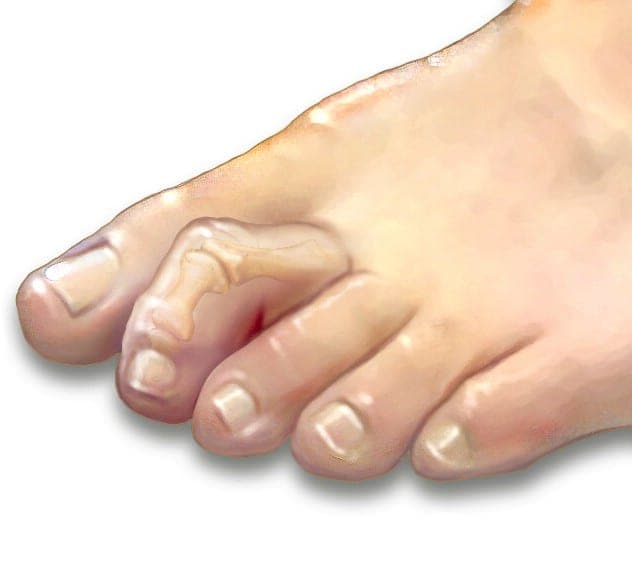
An illustration of a hammertoe.
A hammertoe is a deformity in which one or more of the smaller toes bends or contracts abnormally instead of remaining straight. Depending on which joints and tendons are involved, these deformities may also be referred to as mallet toes or claw toes. Toes can also deviate from side to side and, in more advanced cases, may cross over or underneath neighboring toes.
Hammertoes are commonly associated with an imbalance of the muscles and tendons that control the toe. Over time, the tendons can tighten and shorten, gradually pulling the toe into a contracted position. Initially, the toe may remain flexible and can be manually straightened. As the condition progresses, however, the deformity may become rigid or fixed.
Pain can occur in several different locations. The prominent knuckle of the contracted toe may rub against a shoe, producing irritation, redness, calluses, or sometimes an open sore. The abnormal position of the toe can also create a retrograde force against the metatarsal, contributing to pain in the ball of the foot. Some patients develop pain or callusing at the tip of the toe, while others experience irritation between adjacent toes from excessive side-to-side pressure.
Over time, the involved joints may become enlarged and arthritic and, in severe longstanding cases, can become extremely stiff or partially fused. Hammertoes may become particularly uncomfortable with prolonged standing, walking, exercise, tight-fitting shoes, or high heels.
What Causes Hammertoes?
Hammertoes can develop for several reasons, including muscle and tendon imbalance, abnormal foot mechanics, shoe pressure, and other structural deformities of the foot.
They are also frequently associated with bunions. As a bunion progresses, the great toe may push against the second toe. This can force the second toe upward, sideways, or across the great toe, eventually contributing to a crossover toe and hammertoe deformity. Similar forces can affect the remaining lesser toes and cause them to contract or deviate.
Diagnosing a Hammertoe
Diagnosis begins with a careful physical examination of the foot and toes.
One of the most important things I evaluate is whether the hammertoe is reducible or nonreducible. A reducible hammertoe can still be manually brought toward a normal position, while a nonreducible hammertoe has become relatively rigid or fixed.
This distinction is important because flexible and rigid hammertoes may require very different approaches if surgery becomes necessary.
Weight-bearing X-rays can also help determine the severity and position of the deformity and identify associated conditions such as arthritis, previous fractures, bunions, abnormal metatarsal alignment, or other structural problems contributing to the deformity.
Conservative Treatment
Not every hammertoe requires surgery. If symptoms are manageable, conservative treatment may be enough to reduce pressure and discomfort.
Treatment can include hammertoe splints, digital pads, protective padding, shoe modifications, and taping techniques designed to position the toe more comfortably. Padding can reduce irritation over the prominent knuckle or between the toes. Pads placed beneath the forefoot may also help redistribute pressure away from painful areas in the ball of the foot.
These measures do not necessarily permanently straighten a structural hammertoe, but they may reduce the forces responsible for pain and allow many patients to remain comfortable.
When conservative treatment no longer provides adequate relief or the deformity interferes with walking, exercise, shoe wear, or everyday activities, surgical correction can be considered.
Surgical Treatment of Hammertoes
There is no single operation that is appropriate for every hammertoe. The procedure should be selected according to the type and severity of the deformity, whether the toe remains flexible, the condition of the joints, associated deformities, and the individual patient's needs and goals.
For a reducible or flexible hammertoe, correction may primarily involve the soft tissues. Procedures can include releasing or lengthening contracted flexor or extensor tendons and, when necessary, releasing tight joint capsules or other soft-tissue structures that prevent the toe from returning to a more normal anatomical position.
A nonreducible or rigid hammertoe may require correction of the bone as well. This can involve removing a small portion of bone at the contracted joint to allow the toe to straighten. Depending upon the procedure and the stability of the correction, fixation may include a temporary pin, an absorbable pin, an internal implant, or another method of stabilization. In selected cases, fusion of the involved joint may be appropriate.
Most importantly, the procedure should address why the toe became deformed in the first place. Correcting a hammertoe without considering an associated bunion, abnormal metatarsal position, tendon imbalance, or neighboring toe deformity may fail to address the underlying mechanical problem.
The goal of treatment is not simply to make the toe appear straighter. The goal is to reduce pain, improve function, restore a more normal anatomical position, and allow the patient to return comfortably to the activities and shoes that are important to them.
Have questions about your own feet?
Request a consultation with Dr. Moy to discuss your options.
This website provides general educational information and reflects Dr. Moy's clinical experience and professional opinions. It is not a substitute for an individual medical examination, diagnosis, treatment plan, or emergency care.
Every patient's anatomy, health, bone quality, procedure, healing response, and recovery are different. Recovery milestones and outcomes described on this website are typical or reported experiences and are not guarantees.
Patients should follow their own written postoperative instructions and contact the office promptly with unusual symptoms. Sudden chest pain, difficulty breathing, fainting, or another emergency requires immediate emergency medical care.