
Hammertoe
Written by Richard R. Moy, DPM, FACFAS, Podiatric Foot & Ankle Surgeon, bunion surgery experience since 1992.
Last medically reviewed: August 9, 2026
What is a Hammertoe?
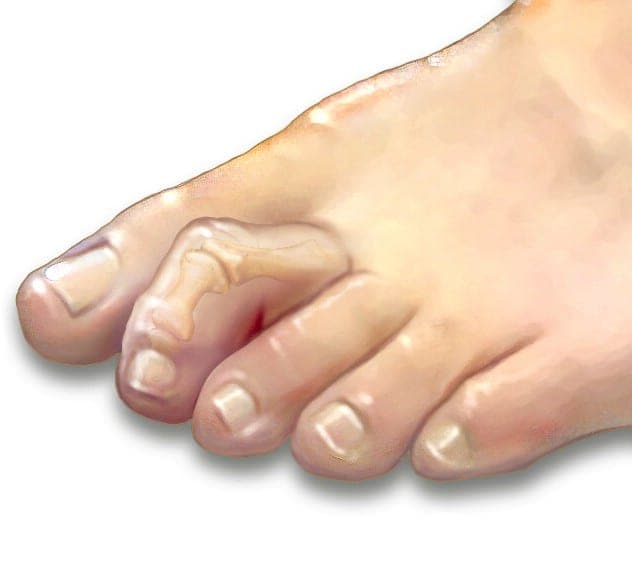
An illustration of a hammertoe.
Hammertoes, also known as clawed toes, crooked toes, or mallet toes, occur when a toe bends abnormally at one of its joints instead of resting flat. They're often caused by a muscle or tendon imbalance from an unnatural walk or foot mechanics, or by genetic predisposition. The American Academy of Orthopaedic Surgeons points to footwear as a common aggravating factor as well, particularly shoes with a narrow toe box or high heels that force the toe into a bent position until the muscles and joints tighten permanently.
Signs of hammertoes are a toe, most often the second toe, that is bent into a claw-like position, a stiff tendon that prohibits the toe from resting flat, or a bunion on the big toe that crowds and forces the adjacent toe into a cramped position.
Diagnosis
A hammertoe is usually diagnosed by physical exam: checking whether the toe can still be straightened manually (flexible) or is fixed in its bent position (rigid), and identifying any underlying cause, such as a bunion, that may be crowding the toe. X-rays help confirm joint alignment and rule out other contributing deformities.
Treatment Options
Flexible hammertoes can often be managed with wider shoes, toe splints or padding, and stretching exercises. Rigid hammertoes, or ones that remain painful despite conservative care, are typically corrected surgically by realigning the joint and, when a bunion is contributing to the crowding, addressing that as well.
When to See a Surgeon
If a hammertoe is painful, rubbing against shoes, or no longer able to be straightened by hand, it's worth having it evaluated for treatment before it becomes rigid.
Have questions about your own feet?
Request a consultation with Dr. Moy to discuss your options.
This website provides general educational information and reflects Dr. Moy's clinical experience and professional opinions. It is not a substitute for an individual medical examination, diagnosis, treatment plan, or emergency care.
Every patient's anatomy, health, bone quality, procedure, healing response, and recovery are different. Recovery milestones and outcomes described on this website are typical or reported experiences and are not guarantees.
Patients should follow their own written postoperative instructions and contact the office promptly with unusual symptoms. Sudden chest pain, difficulty breathing, fainting, or another emergency requires immediate emergency medical care.