
Tailor's Bunion
Written by Richard R. Moy, DPM, FACFAS, Podiatric Foot & Ankle Surgeon, bunion surgery experience since 1992.
Last medically reviewed: August 10, 2026
What is a Tailor's Bunion?
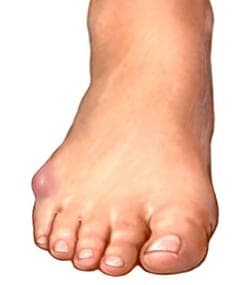
An illustration of a tailor's bunion.
A tailor's bunion, also called a bunionette, occurs next to the small toe on the outside of your foot. It forms when the fifth metatarsal bone shifts outward, creating a bony bump that rubs against shoes and can become red, swollen, or painful. It's essentially a mirror image of a great toe bunion, occurring on the opposite side of the foot.
Diagnosis
Dr. Moy diagnoses a tailor's bunion with a physical exam and an X-ray to measure the angle of the fifth metatarsal and confirm the extent of the deformity. This helps determine whether conservative care is enough or whether surgical correction is the better path.
Treatment Options
Wider shoes, padding, and activity modification can relieve mild symptoms. When those aren't enough, surgical correction is an option. The surgical procedure that corrects a tailor's bunion is nearly identical to the procedure Dr. Moy performs on the great toe bunion: a minimal-incision approach that realigns the bone.
Patients are required to wear a walking boot for four weeks, just like with the great toe bunion procedure, and are typically walking on the foot during that recovery period.
When to See a Surgeon
If the bump is painful, keeps you out of regular shoes, or conservative measures haven't helped, it's worth having it evaluated for surgical correction.
Have questions about your own feet?
Request a consultation with Dr. Moy to discuss your options.
This website provides general educational information and reflects Dr. Moy's clinical experience and professional opinions. It is not a substitute for an individual medical examination, diagnosis, treatment plan, or emergency care.
Every patient's anatomy, health, bone quality, procedure, healing response, and recovery are different. Recovery milestones and outcomes described on this website are typical or reported experiences and are not guarantees.
Patients should follow their own written postoperative instructions and contact the office promptly with unusual symptoms. Sudden chest pain, difficulty breathing, fainting, or another emergency requires immediate emergency medical care.